
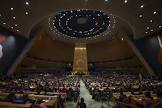
NEW YORK, 17 NOVEMBER 2026, (TON): At the United Nations, by a recorded vote of 108 in favour to 1 against (United States), with 47 abstentions, the 193-member Assembly adopted a resolution on “Cooperation between the United Nations and the Commonwealth of Independent States” (A/81/L.1/Rev.1). It also adopted a resolution on cooperation between the United Nations and the Organization of Islamic Cooperation (A/81/L.13) by a recorded vote of 112 in favour to 6 against (Armenia, Cyprus, Greece, India, Israel, United States), with 39 abstentions.
By the terms of the resolution on the Organization of Islamic Cooperation (OIC), introduced by Iraq’s representative on the Organization’s behalf, the Assembly called for stronger collaboration on peace, security, and conflict prevention. It encouraged both organizations to advance the New York Declaration on the Peaceful Settlement of the Question of Palestine and the Implementation of the Two-State Solution, while welcoming cooperation on counter-terrorism, combating Islamophobia, and human rights.
The representative of the United States, speaking in explanation of vote before the vote, said that his delegation would vote no on the resolution on cooperation with the Organization of the Islamic Conference as it contained “numerous instances of language that the United States cannot accept, including vague and undefined language on violent extremism and references to organizations from which the United States has withdrawn, having found them to be redundant in scope, mismanaged, wasteful, poorly run” and captured by the interests of actors advancing their own agendas.
India has objected exclusion of New Delhi and several other countries from consultations on a United Nations resolution concerning cooperation with the Organisation of Islamic Cooperation (OIC). India voted against the draft at the UN General Assembly, which was adopted on 16 November 2026. India's Deputy Permanent Representative to the UN, Ambassador Yojna Patel, accused Turkey of deliberately keeping certain countries out of discussions while successive drafts of the resolution were being circulated. She described the move as a violation of the principles of transparency of the United Nations and called it a "concerning matter" which required an investigation.